Rochelle Youk is a multidisciplinary artist (and a good friend) who works in a variety of media, from the expected (paper, cloth, canvas) to the unorthodox (cigarettes, hair, fermented soybean paste). She has been exhibited widely across the Bay Area and beyond, including the Kala Art Institute, Root Division, and the Berkeley Art Center.
Her work is often detailed and labor-intensive, requiring hours of repetitive steps. I find her art intriguing, challenging, and beautiful, and have been struck time and again by her deep sense of artistic curiosity. She is also a researcher at heart and can spend many happy hours researching, for example, Korean horsehair hats at the East Asian Library at UC Berkeley.
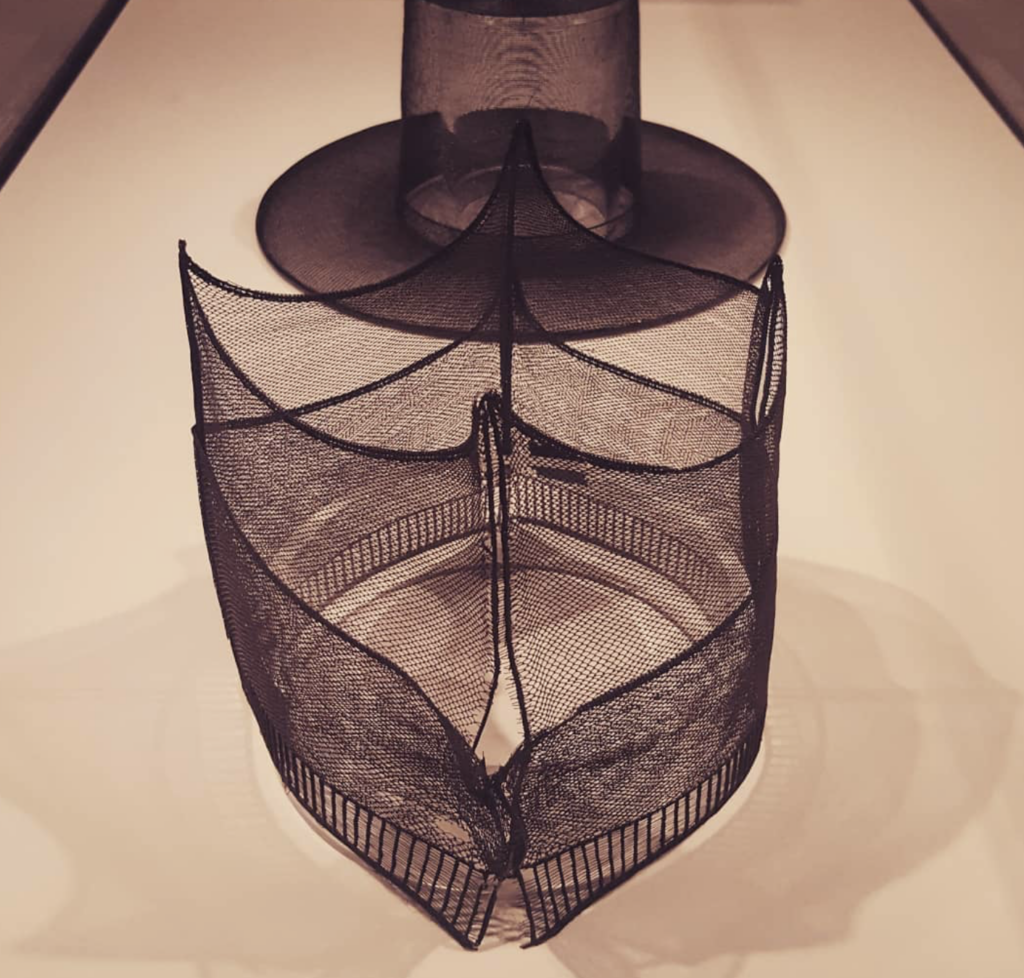
Her interest in research probably led her to pursue graduate studies in Asian American studies at San Francisco State. But before she went back to school, she worked for over a decade as a bookbinder at Arion Press, a letterpress publisher in San Francisco.
I wanted to speak with Rochelle about how she kept making art while holding down a demanding day job, this topic of “the artist in everyday life” that is the subject of *my* curiosity.
You worked for many years as a bookbinder, in a job that was adjacent to (but distinct from) your art practice. What were the pros and cons of that?
When I first started [at Arion], it was such a physical job that I didn’t have the energy to do anything afterwards. We were on our feet all day. I felt zapped physically because I wasn’t used to full-time manual labor. I remember one of my coworkers would fall asleep in the hallway after work, holding a bag of chips or whatever, because she was so tired. But also, the work was just creative enough to scratch that artistic itch. I participated in a couple of shows, but it was with work that I had already made.
When did that change?
After a while, I really missed making the things I wanted to make, I guess.
And, actually, working in the bindery was complementary to my artistic process because I had a lot of time to think. We weren’t allowed to listen to music or podcasts, so I spent a lot of time thinking about projects that I wanted to make. I eventually got into the habit of writing things down as they struck me, and that became a part of my practice.
I would also have conversations with other people working there who were thinking about creative projects, too. Think or talk to other people–those were basically the two options, so we spent a lot of time talking. We’d make up games to entertain ourselves or talk about silly things. Sometimes we would buy lottery tickets as a group and then daydream about what we would do with that money.
Eventually, I started renting a studio, and that was really helpful. Just having a separate space from my home where I could go and say, “Okay, this is making time.”
I still didn’t have that much time to make stuff, but then I was able to take a month off and go on an artist residency. That was when I realized I had a whole list of projects. I got to the residency and hit the ground running, and I made so much stuff. I realized this was a rhythm I could work with — reflect for a few years, then make a whole bunch of stuff.
What have been the lessons of how you’ve pursued your art practice?
When I was in art school, they drilled it into us that most of us would not be making a living off our art. I do have friends who have found success, being connected to galleries and such. A lot of them talk about how having to think about your work in terms of sellability can change your work.
If you don’t go that route, you have the freedom to make what you want to make and how you want to make it. But then resources become the limiting factor: time, space, materials.
One of my big life lessons over the years—this seems very simple, and I am like embarrassed that it took me so long to like realize this—but you can make artwork about whatever you like, whatever you’re interested in. And it’s okay.
What do you mean?
Back when I was getting my MFA, the predominant message was that you needed to make work that transcended your identity in order to appeal to a broader audience…meaning the white audience. I feel like I really just like internalized that. So, to me, good art was art that could be about something specific to me, but the broader read would be something that fit into formal categories that people thought were good. There were different schools, like Western or European schools of art, that I felt I needed to be part of, even though I was spending all this time researching Korean folk crafts or the history between the U.S. and Asia.
It wasn’t until the pandemic that I realized I could just make what I want. If I’m interested in something, that’s reason enough to make work. Being a “serious artist” means, for me, redefining what success actually means.
What I’m reading
- I finished An Immense World by Ed Yong, which explores—in example after incredible example—the concept of umwelt: the ways various animals experience the world. In case you were wondering…animals are amazing.
- I’m halfway through Daniel Mendelsohn’s translation of The Odyssey.
- I’m loving The End of August by Yu Miri, a Korean author writing in Japanese. The book won the National Book Award for a translated work. The translator was Morgan Giles; I found her blog posts on translation fascinating.
Life, lately
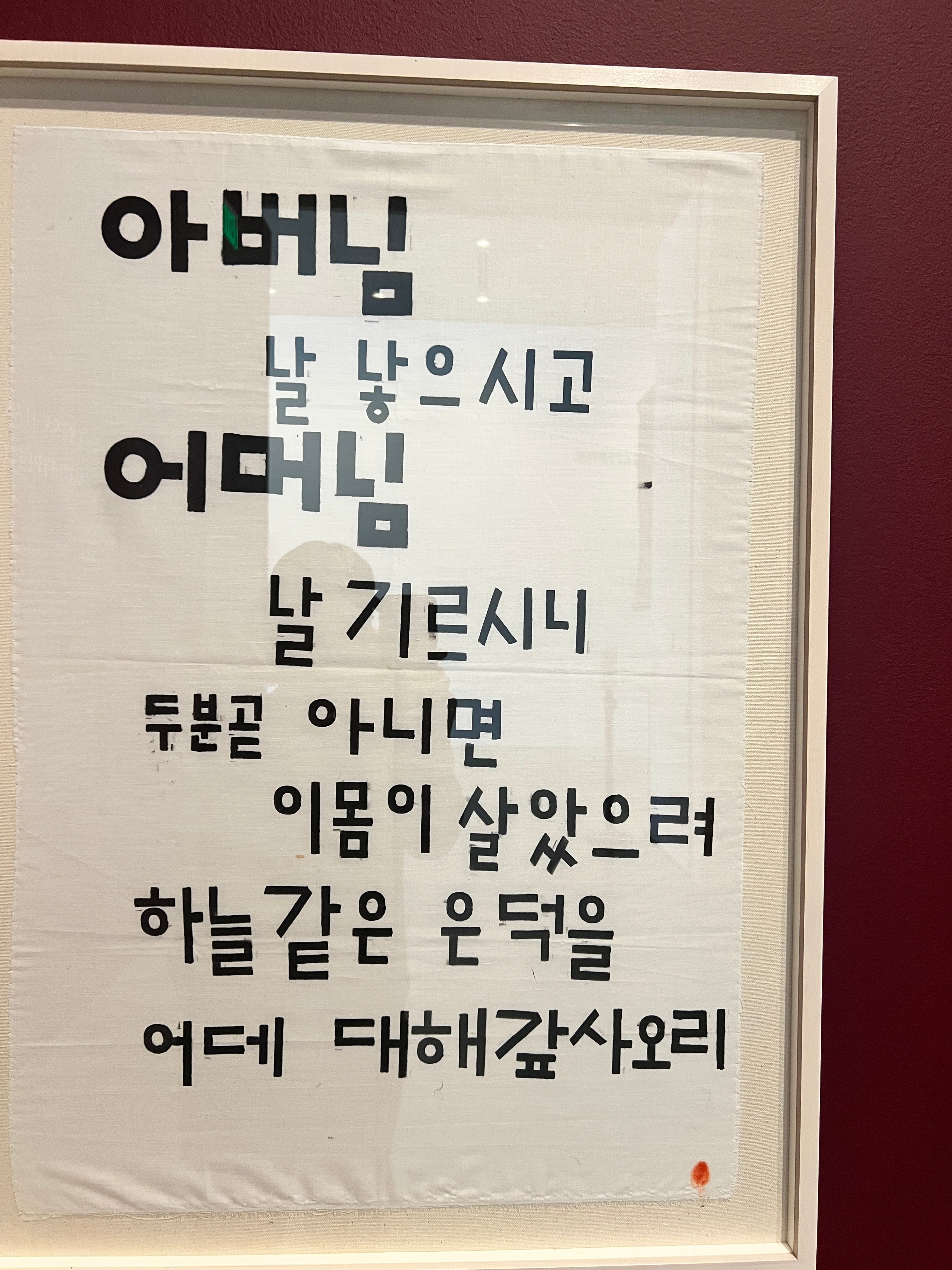
I had a chance to check out the BAMPFA’s exhibit, Theresa Hak Kyung Cha: Multiple Offerings. I believe UC Berkeley is the holder of Cha’s full archive, and it was interesting to see so much of her avant-garde work on display. Text, performance, sculpture…Cha was a graduate student at Cal when she was violently murdered. Her creativity, originality, and terrible, untimely death has garnered her something of a cult following.
Sign up for my newsletter
You can get these posts delivered to your inbox every other week by signing up for my Substack Newsletter.